Focus on the Conversation
In my writing groups, we often ask each other about who we’re reading. To write well, we must read. To learn from what we read and apply it to our writing, we need to deeply engage with the material.
In a writing workshop I go to, one of the moderators regularly mentions being “in conversation” with an author. All text is a conversation. If we come to it this way, we will naturally learn methods to continue conversations with authors through our reading and writing.
When I read, I annotate the text. If I especially enjoy a section, I mark it. If I am curious about a choice or an argument, I question it. If I think about similarities to other works that I’ve read, I note them next to the text (and later make digital summaries).
Below, I share an example of annotations in a non-fiction book that I enjoyed. In Neal Allen and Anne Lamott’s book, Good Writing, Rule 35, Finish the Damn Thing, resonated with me. One of my favorite lines in this book is when Neal Allen quotes Anne Lamott about removing the expectation that writing will go well.
As my buzzkill wife is known to say about the writer’s life, “It’s going to go badly.”
Allen says that we should remove the expectation that things will go well, that “the logjams in the middle were always going to show up to be sorted out.” Once we conceptualize that problems are just a part of the process, we will be better prepared to move forward.
Lamott likens working through a writing project to being in labor.
Think of finishing as a little like being in labor, where you realize ten hours in that you don’t even actually like children. Breathe. Push.
I can write for hours at a time, but finishing, letting go of my words to have others critique, review, and pick them apart—that step most challenges me. I am working through it. Like Lamott, I don’t expect every project to go well at all times, but I am recommitting myself to a focused writing practice, partially by reading more deeply.
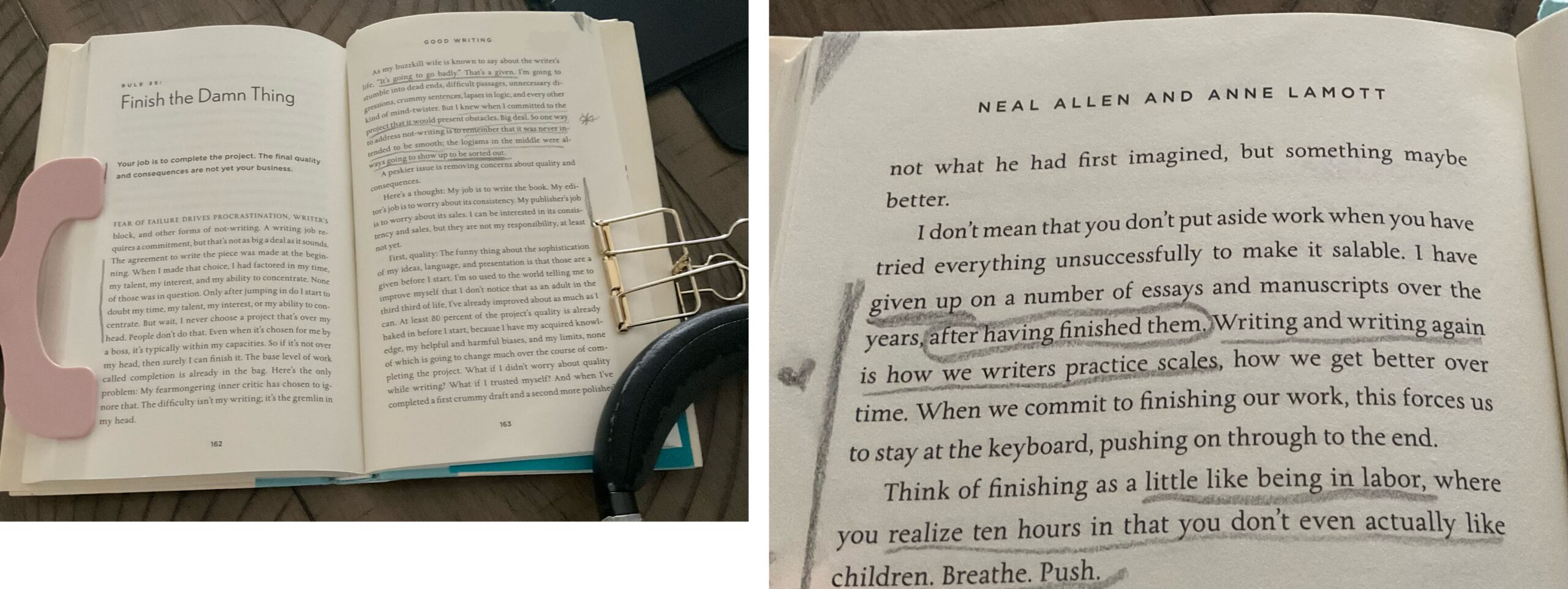
Examples of my analog annotations in Neal Allen and Anne Lamott’s book, Good Writing: 36 Ways to Improve Your Sentences
When reading academic texts, I am often pulling from many sources to understand connections between the authors’ research and prior research. I also think through the limitations of the studies to determine potential next steps for the field. Below, I share an example of my annotations on an experimental study on the effects of environmental noise and steady-state noise (like the sound of rainfall) on sleep quality. I wrote a reflective summary on these findings on Substack.

An overview of digital annotations on a PDF copy of an experimental research study that involved the effects of different types of noise on sleep quality.
Reading is an active process. To learn from what we read and deeply encode (i.e., learn) the information, we must engage with the text. One way to do this is to converse with what we read through our writing. When I read, I annotate text, connect it with prior information, and regularly revisit my notes. With this process, I find conversations that I want to continue. And, when I set aside a quiet moment, those conversations help me to write.
Notes
- I’d love to hear from you. Chat with me directly and send feedback, questions, or article requests to my new email thoughts at emilyhokett.blog.
- Find more of my writing on Substack, Medium and here at emilyhokett.blog.
- Buy me a tea🍵 to support the maintenance of the blog.
Take care. Talk soon.